Solutions Marketing Group

Providing clients with innovative strategies that position them to understand, penetrate and retain the disability market.

  • Home
  • About
  • What We Do
  • Blog
  • Learn From Us
    • Boot Camp
    • eBook
  • Contact
  • Home
  • About
  • What We Do
  • Blog
  • Learn From Us
    • Boot Camp
    • eBook
  • Contact

A Virus Worth Catching

November 11, 2013

By Joan Leotta

Viral videos infect us with laughter, touching moments, and fun. Guinness beer recently released an ad that has gone viral at http://www.youtube.com/watch?v=xwndLOKQTDs. This ad touches the heart of many and at the same time promotes a picture of people with disabilities as active, vibrant individuals.

Screenshot of video - click to view

“Basketball”: The ad

Whether you drink beer or not, you have probably seen the Guinness video showing a group of guys playing basketball in wheelchairs. The video has caught on with thousands of people who simply love the image of human interaction. Whether it will translate into more sales of Guinness is yet to be seen, but certainly the video has struck a chord with many, and the Guinness name will likely be indelibly linked to that positive viewpoint.

Doug Campbell, Brand Director at Guinness, says, “Our goal creatively was to be uplifting and we were drawn by people who do inspiring deeds, not for the glory, but because they possess a depth of true character.” He names BBDO New York as the agency behind the ad.

“This ad exemplifies the essence of that character and male kinship,” he says, showing “ordinary people demonstrating support for their buddies in a natural, unheralded way.”

The ad was originally intended for the US market only, but has become so popular that Guinness is airing it in Jamaica, Great Britain, Ireland, and Canada. Recognizing the broad appeal of the ad’s message, Campbell notes, “This ad is not about disabled sports, per se. Rather, it is about the kinship and loyalty among good friends that inspires people to do things they might not otherwise do to support people they care about. It depicts a group of friends playing basketball together and how people inclusively rally around their friend in a meaningful way.”

The promotion highlights a Guinness credo in that it “exemplifies friendship, inclusion and camaraderie,” says Campbell, “everything in which Guinness believes.”

Going viral

Guinness says it did not intend the ad to go viral and did not pay for additional promotion of the ad through YouTube as some companies do. However, the efficacy of viral videos is well documented. A 2010 Inc. magazine article by April Joyner (http://www.inc.com/magazine/20100201/using-viral-video-to-boost-sales.html/1) explored the value of using videos to promote products and add positive associations to a company’s message. For example, the article describes the success of Smule, a Palo Alto, California, maker of iPhone apps. The company produced two demos for its Ocarina app, which lets the iPhone function as a kind of flute. Those videos attracted a combined 1.5 million viewers.  According to Joyner’s article, “The videos’ successes have translated into brisk sales for Smule. Ocarina is one of the iPhone’s top-selling apps, having been downloaded more than 1.5 million times, at 99 cents each.”

Joyner also documents a case more similar to Guinness’, in which a video was produced not so much to promote a product but to communicate what the brand represents. Her article describes videos produced by robot maker Kiva Systems that have “value beyond tracking by sales increases.” In the article, Mitch Rosenberg, Kiva’s vice president of marketing, is quoted as saying, “These types of videos are primarily for fun, but the secondary effect is that people hear about a practical way to use a robot.”

In the case of Guinness, the ad is a strong fit for the company’s overall outlook. According to Campbell, “‘Basketball’ is the first execution in our recently launched ‘Made of More’ campaign.” However, although the campaign may be new, the desire to express support for great character, passion, and drive is centuries old.

“For Guinness, these values have been core to the brand for more than 250 years,” says Campbell, “when Arthur Guinness first decided to experiment with a different kind of beer that would offer more character and flavor than other brews on the market.”

The way that the video was made underscores the firm’s commitment to inclusion. According to Campbell, Guinness sought input and received support from the Reeve Foundation throughout. They consulted with this leading research and advocacy organization for people with spinal cord injuries in order “to ensure that no offense would be caused while creating the ad,” Campbell relates.

“Their President and CEO, Peter Wilderotter, has shown his full support for the ad,” Campbell says, “and applauded Guinness for raising awareness of spinal cord injuries in a way that puts a spotlight on the everyday challenges of living with paralysis.”

Guinness also incorporated feedback and guidance from Joshua Campos, himself a disabled wheelchair basketball athlete and coach. “Campos is the coach of a wheelchair basketball team affiliated with the LA Clippers NBA Basketball Team,” Campbell explains. “He’s been an active competitor for more than six years. That intimate knowledge of the game kept us honest and, in our opinion, helped make for a memorable, authentic story.”

While the company has not yet documented the number of views, Campbell notes, “Overall, we have received overwhelmingly positive responses to the ad. People, disabled or not, seem to understand and appreciate the message.” He continues, “Guinness thanks everyone who has watched, shared with their friends, and shown their support.”

Success with this video is just the beginning of Guinness’ plan to give back to the community. The next part of the “Made of More” campaign is a recently-launched initiative to help raise $1 million in support of local firefighters. Campbell says, “We believe that firefighters also embody the spirit of ‘Made of More.’” In partnership with The Leary Firefighters Foundation, from now until St. Patrick’s Day adult Guinness fans can purchase commemorative firefighter-themed t-shirts benefitting that Foundation on www.GUINNESSGivesBack.com, the online hub for all philanthropic efforts surrounding the brand’s commitment to local firefighters.

Just like the Basketball ad, the firefighter campaign satisfies Guinness’s impulse to celebrate character, passion, and drive. “Made of More” may prove Guinness to be not just a beer of strong character, but the brew of choice for ale drinkers of the same quality.

Edited by Mary-Louise Piner.

Filed Under: Profiles in Excellence Leave a Comment

Tags: Guiness, inclusion

find this post helpful? Try these:

Default Thumbnail“Fit Is Our Superpower”: JCPenney A Caroline Cart from TargetFree to Shop: TARGET’S Adoption of Caroline’s Carts Heralds a New Era in Inclusion
share

OXO: Getting a Grip on Usability and More

November 11, 2013

OXO's easy-to-grip vegetable peeler

OXO’s easy-to-grip vegetable peeler

How does a vegetable peeler become the inspiration for a multi-million–dollar company? For a retired houseware company founder watching his wife have difficulty using certain kitchen tools, , the journey began in a vacation home in France and is still going strong 23 years later.

From the beginning, the driving factor for the OXO line of kitchen tools was Universal Design: producing items that ensure greater ease of use for as many people as possible. Over the years, the company’s line of products grew from its easy-grip peeler and fourteen other debut items to now include an assortment of more than 850 household necessities.

Background

OXO was the brainchild of Sam Farber, the founder of houseware company called  Copco. Farber had sold his original company in 1982 and was enjoying the retired life when he noticed his wife having trouble handling a basic kitchen peeler due to a slight case of arthritis.

Farber’s strong sense of design and entrepreneurial spirit was piqued. He got to work modifying kitchen tool handles using modeling clay to try and come up with more comfortable alternatives.  Farber contacted his good friend Davin Stowell, the founder of Smart Design, a New York Industrial design firm committed to Universal Design. Together with his son and wife, Farber started OXO with a line of fifteen “Good Grips” items, including an improved peeler with a more comfortable handle.  The company name, “Ox-oh”, is also a nod to Universal Design since it can be read from any direction – horizontal, vertical, upside down or backwards, which also underscores the company’s commitment to versatility.

The company made its debut at the Gourmet Products Show in San Francisco in 1990. Its swivel peeler retailed for around $6 at a time when the average peeler was available for $2. But the now-signature   oversized black handles (made of a type of rubber calledSantoprene) and the easy-to-hold shape and angle of the handle immediately created a stir in the industry.

Design Philosophy

OXO spokesperson Gretchen Holt describes the company’s underlying philosophy like this. “For OXO, [Universal Design] means designing products for young and old, male and female, lefties and righties and many with special needs.”

As her words show, this guiding principle drives the overall quality of all that OXO makes. “The goal of making products more usable forces us to first identify problems and inefficiencies of existing products (including our own!),” she says, “not only in terms of comfort, but performance as well. This gives us the foundation to meet our commitment of making products that make a tangible improvement in peoples’ daily lives.”

Today, the inspired peeler remains a strong seller for the company although, according to the OXO website, the salad spinner is the most popular item. Another one of the premiere sellers is the OXO mandolin, a safer-to-use version of the familiar slicer that produces thin cuts of fruits and vegetables without putting fingers and hands at risk.

Company Growth and Outgrowth

For the majority of the company’s ergonomically-designed tools, decisions on what to create are based on feedback from users, retailers, inventors. “We talk with people of all ages and abilities,” explains Holt, “but we do not target specific groups except when it comes to baby products, one of our newest lines.”  The goal of the baby line is to provide items that are easy for parents to use and safe for baby, widening the company’s scope but keeping to its basic mission.

Now, OXO makes over 850 items under six different brands. The company continues to grow in popularity, even during the recession, with sales increasing yearly. Between 1991 and 2009, OXO’s annual growth rate in sales was 27%.

Smart Design Group has continued to collaborate with OXO on many designs, garnering awards for tools that have improved productivity and comfort in many arenas. The Smart Design website describes the alliance as a collaboration with OXO as it expanded beyond the Good Grips premium line and reached out to the mass market, to bring the principles of Universal design to a wider audience. In cooperation with Smart Design Group, OXO has applied the Good Grips philosophy to new categories such as hardware, gardening tools, office supplies (for Staples) and other areas, as well as expanding into products for young families, e.g. the OXO Tot, collection. In addition to all of this, OXO has collaborated with other companies like pharmaceuticals company UCB, on the award-winning Cimzia home injection syringe, which makes it easier for people with rheumatoid arthritis to improve their quality of life.

Awards

From its inception, OXO won recognition for innovation, starting with an honorable mention in the consumer products division in 1991 fromInternational Design Magazine’s Annual Design Review. Other honors include one for excellence from the National Arthritis Foundation; a 2011 Fast Company endorsement as one of the ten most innovative companies in consumer products, and the 2013 Top Pick award fromConsumer Reports for the Tot Sprout Chair.

OXO is currently owned by the Helen of Troy company. Founder Farber, died in June of 2013, leaving a heritage of better products that make live easier for people of all ages and abilities.

———-

For More information on OXO, visit www.OXO.com.

Edited by Mary-Louise Piner.

Filed Under: Profiles in Excellence Leave a Comment

Tags: oxo, universal design

find this post helpful? Try these:

No related posts.

share

School of Thought and Deed: CUNY Disability Stuides Program

July 1, 2013

By Joan Leotta

CUNY School of Professional StudiesUniversities are in the business of transforming lives through ideas. City University New York (CUNY) has taken that vocation one step further. CUNY, an institution of 23 campuses spread over the NYC metro area with more than 250,000 students, wants to transform attitudes about people with disabilities. At the same time, a particular CUNY program has very concrete aims: to educate the frontline workforce and create career opportunities for people with disabilities and those who serve them.
The vehicle for both transformations is the Disabilities Studies Program, offered by CUNY’S School of Professional Studies (SPS). In 2013 CUNY SPS will offer the nation’s first online master’s degree program in disability studies, along with existing Online Bachelor’s Degree and a Graduate Certificate programs in the same discipline. The program is designed to offer and opportunity to explore the relationship between society and disability to help students gain a broader view of the issues they encounter on a daily basis.

The program combines multidisciplinary perspectives on disability with coursework designed to spark innovation. Graduates of the program have the potential to develop new policies and new approaches to disability barriers. Program participants develop tools to help transform obstacles into stepping stones, taking people with disabilities to higher levels of achievement.

How the Program Began

The online master’s degree program has its roots in the activism of a presidential family. Mariette Bates, Academic Director of Disabilities Studies, explains: “Twenty-four years ago … John F. Kennedy, Jr. was challenged to do something positive in the disability field here in the city. In 1989, after researching needs in the field, he decided to focus on the needs of the frontline workforce.  He worked with Bill Ebenstein, now CUNY’s University Dean for Health and Human Services, to develop  courses on  CUNY campuses for those target workers serving individuals with disabilities.

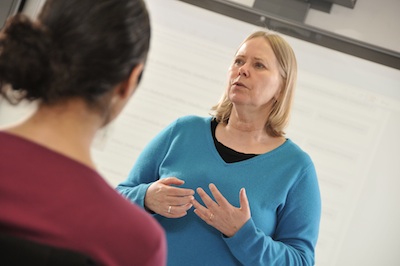
Mariette Bates, Academic Director of the CUNY Disabilities Studies program, teaches a class

Mariette Bates, Academic Director of the CUNY Disabilities Studies program, teaches a class.

“The idea was to strengthen the primary relationships workers have with those they serve,” Bates continues, “and to broaden the background knowledge of those already in the field, increasing their chance to rise into management. At the time we began there were no particular programs targeted to workers serving people with disabilities, using a person-centered perspective.”

Kennedy also created a fellowship for CUNY students who work in the field. Kennedy Fellows receive a scholarship and mentoring opportunities. In the past two decades the program has selected over 800 students to become Kennedy Fellows.Bates taught a course on Introduction to Developmental Disabilities in the early days of the program and served as a mentor to Kennedy Fellows.

In 2003, CUNY created the School of Professional Studies to further the education of working adults in New York City. The Disability Studies Program began at the newly created school with a graduate certificate in 2004. The Master’s Degree began as a face-to-face program in 2009.

Says Bates, “Our programs are aimed not only at getting people in the trenches to think bigger thoughts about disability and society, but also to provide a way for those in the field to do more, kick-starting their creativity. Our classes provide forums in which people can put together their practical knowledge and the newly-minted theoretical immersion to find new practical solutions to removing barriers to people with disabilities.”

Who Take the Classes

In 2012, CUNY SPS created the Online Bachelor’s Degree program for people who need to finish college. The Master’s Degree is coming online in the fall of 2013. Online courses provide flexibility to students who self-identify as having a disability and therefore might be better able to complete the courses in the comfort of their own homes and with their own adaptive computer equipment. In addition, workers who cannot attend school face-to-face because of family responsibilities have another option to finish their degree.

Another benefit to presenting the classes online is the opportunity to broaden the student base geographically. Although most of the students still come from the metro New York area, as the program becomes better known, its reach can grow. Bates adds, “Online students have the advantage of paying in-state tuition no matter where they live.”

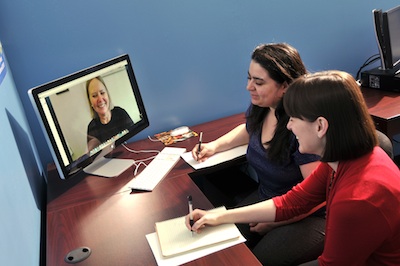
Two students interact with Mariette via Skye

Two students interact with Mariette via Skye

Katie DeFoe, Assistant Director of the program, reports, “Of course the number of students and the ratio of those with disabilities changes each semester, but in general, there are about 90-100 students in the masters program and about 15-20 now in the Graduate Certificate program. The Bachelor’s Degree Program has about thirty enrolled and we get more and more applications each day.”

Because the program had such strong ties to service agencies, about 75% of the students in the MASTER’S DEGREE program already work in the field in some capacity. About 15% of  the disability studies  students self-identify as having disability.

Bates points out that the specialty of disability expertise is a relatively new one and not everyone understands what can be gained by taking it. She says, “With these resources and qualifications under their belt,” she explains, “now people with disabilities can become advocates not only for themselves, but also can have an opportunity to be in positions that will affect disability policy.”

The Bachelor’s Degree, Master’s Degree and Graduate Certificate programs are open to all who meet certain educational requirements, described below.  The Kennedy Fellows program is administered by the Office of the Dean of Health and Human Services and has specific requirements for applicants. Limited scholarship aid is available at all levels for qualifying students.

Teaching and Placement

By offering classes online, the programs (can) attract an eclectic mix of instructors with various real-world viewpoints. Faculty members include both various full-time CUNY professors and expert practitioners from the field. DeFoe says, “About 58% of our current faculty either have disabilities or are parents of or have siblings with disabilities.”

People from other CUNY disciplines such as the School of Social Work or the rehabilitation fields  often come to the program to learn more about disability in the four course advanced certificate program with a goal of transforming perspectives in their fields.

The Future

The program should leave a lasting legacy to improve the working lives of people with disabilities. “One of the things I value about these programs,” says Bates, “is that they have the power to transfer that knowledge and energy to future generations.

“These programs offer people with disabilities and those who support them an opportunity to dialogue face to face and online,” she continues. “Each class provides a safe place to explore issues related to disability and have some profound dialogue and that will transform the field—and remove the stigmas that lead to poverty. These things are really important.”

CUNY SPS Disability Studies at a Glance

Disability Studies is an emerging academic field that explores disability from multiple perspectives, including the social sciences, humanities, science, and the law. SPS offers groundbreaking, fully accredited programs within Disability Studies including:

Online B.A. in Disability Studies (120 credits)

  • The first undergraduate degree program of its kind in the country
  • Earn the necessary skills to improve the lives of people with disabilities
  • Elect one of the four concentrations for in-depth study: Intellectual/Developmental Disabilities; Autism Spectrum Disorder; Mental/Behavioral Health; Interdisciplinary Disability Studies

M.A. in Disability Studies (30 credits) Online courses available

  • The first stand-alone program of its kind in the country
  • Use a “person-centered” approach to the study of disability to uncover a new understanding of society
  • Gain intellectual and methodological tools to assume greater responsibility and leadership roles in the future as service providers, advocates, researchers, or policy makers

Graduate Certificate in Disability Studies (12 credits) Online courses available

  • Examine disability through psychology, history, literature, law, medicine, politics, and urban planning
  • Acquire a deeper understanding of disability studies, including its philosophy, importance in disability research, influence on public policy and impact on service delivery
  • Further or begin a career working with and for people with a wide range of disabilities in community-based and governmental agencies as they evolve in the 21st Century

Contacts
http://sps.cuny.edu/programs/ba_disabilitystudies BA
http://sps.cuny.edu/programs/gradcert_disabilitystudies Certificate
http://sps.cuny.edu/programs/ma_disabilitystudies Master
kathleen.defoe@mail.cuny.edu
mariette.bates@mail.cuny.edu


Edited by Mary-Louise Piner.

Filed Under: Profiles in Excellence Leave a Comment

Tags: CUNY, disability studies, education, Mariette Bates

find this post helpful? Try these:

No related posts.

share

Breathe Deeply: PURE Rooms in Hotels

June 15, 2013

By Joan Leotta

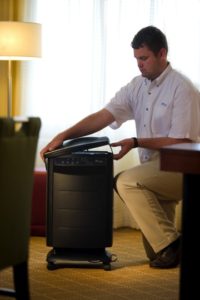
Worker setting up a PURE air filter in a hotel room

Air purification is part of the PURE process

Summer’s coming, and for many, that season means travel. For people with mobility disabilities, the potential barriers when vacationing are many. However, from access to planes to suitable hotel rooms, people who use wheelchairs in the U.S. have ADA guidelines to help insure the comforts of their trips. But what about the perils of touring the country for people for whom air quality — both indoors and out — is an issue?

Brian Brault, CEO of PURE Solutions, recognizes that traditional cleaning products, latent germs in the air or on surfaces, and other everyday allergens present real hindrances to comfortable travel for many hotel guests. Now, with the help of his company, more than 6,000 hotel rooms in North America and around the world are certified “PURE” rooms, prepared so as to eliminate allergens and asthma triggers and thus provide a “breath of fresh air” to hotel guests.

Why PURE?

A 2012 survey of travelers by the Cornell University Survey Research Institute, found that 41% of travelers either have breathing difficulties or travel with companions who do. Brault’s PURE rooms provide the type of accommodation for a health condition that hotel proprietors have been challenged to adequately address in the past.

In a PURE room, the “soft goods” (linens, carpeting, drapery) and hard surfaces are treated to make it extremely difficult for germs to live and the air is constantly filtered for purity. But, more than that, Brault describes the PURE rooms as a natural outgrowth of his firm’s core values: Making lives better, being genuine, and doing whatever it takes. “It’s how we work,” he says.

The PURE room concept began about nine years ago, when Advanced Facilities Services, a service company based in Buffalo, New York owned by Brault was approached by a company who had a patented technology often used to clean cruise ship air filters. Jens Ringvall from Sweden, a principal of this company had developed a way of cleansing the air filter system and the cabins. Brault realized his work could be applied to hotel rooms.

How It Works

PURE’s seven-step process combines advancements in science with concern for the whole guest to produce rooms that are comfortable for anyone whose breathing conditions require such standards. In addition, most hotels who adopt the PURE-room concept convert at least one ADA-compliant room for people with disabilities to PURE

The PURE process, detailed at www.pureroom.com, includes:

  1. Deep-cleaning the air handling unit, down to disinfecting the coils of the heating and air conditioning mechanisms.
  2. Using tea-tree oil cartridges for antimicrobial and disinfectant purposes, to maintain sanitized conditions in the air-handling unit.
  3. Cleaning carpet and upholstery with a patented solution designed to deeply remove dirt, bacteria, and mold.
  4. Employing a one-time “shock” treatment to restore fresh, crisp air by destroying mold and bacteria and removing lingering odors from the likes of cigarette smoke or pets.
  5. Applying the “PURE Shield,” a bacteriostatic barrier, to all room surfaces to repel microorganisms and prevent their growth.
  6. Purifying the air to continuously protect against airborne irritants through a medical grade air purifier.
  7. Using only allergy-friendly bedding, including micro-fiber, mono-filament mattresses and pillowcase encasements.

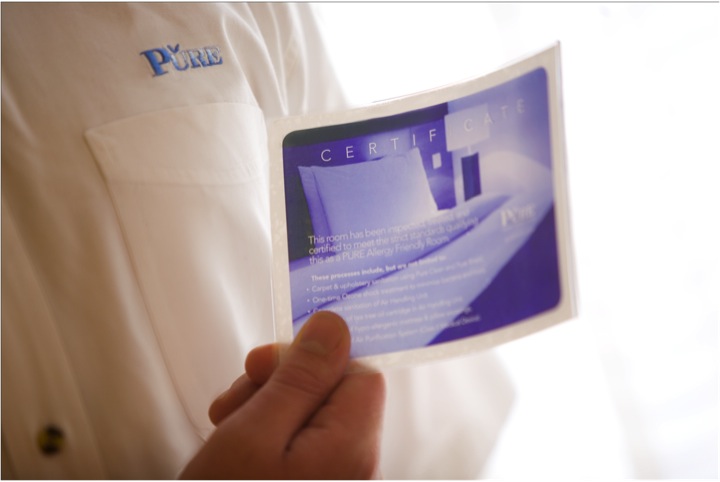
image of a hand holding a PURE certification card

Maintaining PURE standards is not a one-time transaction for hotels, Brault relates. “Once the room is converted and inspected, it is certified,” he says.

Bill Henderson, General Manager of the Westin, Atlanta Airport hotel, adds, “Our staff does the regular cleaning. We use green, low-impact cleaning products.” Every six months, the rooms are re-treated and re-certified by PURE room personnel.”

Marketing PURE Rooms

How prevalent are PURE rooms? Brault notes, “Many of the nation’s best hotels, and all Hyatt full service brand hotels, offer these rooms.” He estimates that hotels who adopt the PURE room concept generally convert about five percent of their rooms to PURE.

To many guests, staying in a PURE room is often an eye-opening (or, a refreshingly eye-closing) experience. “Those staying in PURE rooms often report having the best night’s sleep in many years, even better than in their own homes,” says Brault.

Still, the company is faced with the issue of how to share the success and luxury of clean-breathing air and a good night’s sleep with the public. Originally, the concept seemed to be the right idea at the right time. Says Brault: “We talked to a brand strategist for Hilton and one of the head engineers at Marriott and some of the professors at the Cornell University hospitality program and found that the whole issue of indoor air quality was very much on the radar for the hotel branch of the hospitality industry. Our trial run, about eight years, was successful, and hotel people invested in our product.” He adds that data on the number of travelers with breathing issues were a big factor in convincing hoteliers of the need to offer such rooms in some or all of their properties.

“Early on, we thought the rooms would sell themselves,” says Brault. “In 2008, when we were recognized by the hotel school at Cornell, and awarded the “innovator of the industry”, we went from a few rooms to a lot of rooms.”

However, as in many sectors, dips in the economy forced the company to rethink their marketing strategy. Says BRAULT, “The economy of 2008 and 2009 forced us to work out creative ways to market the rooms, including free installation, with profit-sharing on the premium charged for the room” Most hotels charge about twenty dollars more a night for the PURE rooms.

Westin’s Henderson notes, “We market PURE rooms on our website, in our group information, and in our hotel lobby. Our check-in staff are trained to serve and notice guest needs, so we offer them when we think there may be a need. For instance if the front desk person sees that a guest has a cold or is suffering from an allergy, he or she might recommend the PURE room at check-in.”

For Westin, being mindful of guest needs is part of the culture. ”We are very cognizant of helping people with disabilities,” Henderson says. “All the Starwood Brands are very health conscious anyway…and the desk staff is specially trained to note guest needs.” Westin even goes above and beyond the expected to provide comforts of home. “One of our services is to send chicken soup up to the room of sick guests,” says Henderson.

He relates, “The PURE barrier and air purification system do more than clean the air for those who have air pollution–related breathing issues. Even if you do not have a breathing problem, if you have a cold or are susceptible to colds while traveling, these two factors make the choice of a PURE room a wise one.”

Good press from one hotel helped build trust in the PURE concept throughout the industry. Brault relates that after The Grand Hyatt in San Francisco decided to try the rooms, “We became the brand standard for Hyatt in 2010 under the name Respire(by Hyatt).” (The name will revert to PURE at Hyatt by the end of this year.)

Hyatt Corporate SVP of Rooms, Tom Smith, adds, “Two to five percent of rooms in each hotel are now Respire by Hyatt rooms.” Because the Hyatt chain has a strong global presence, the number of PURE/Respire by Hyatt rooms is high. “We have approximately 2,000 rooms in 125 hotels across the US, Canada and the Caribbean,” he indicates. “More than any other brand. Our guests’ health and well-being is a top priority and every one of our hotels follows a strict protocol for cleanliness.”

How are that many rooms kept in PURE condition? Smith explains that the special procedures for maintaining PURE rooms are a part of every room attendant’s routine. “In Hyatt Respire rooms, after regular cleaning, room attendants ensure that encasements are on the mattress and all pillows, that the purifier is running in ‘quiet’ mode, and that the purification certificate in the room is visible.”

Hyatt is taking an additional step to help those with breathing difficulties by introducing a line of fragrance-free toiletries this year. Smith also notes that the hotel’s food and beverage services also cater to potential allergy issues.

Feedback

PURE rooms generally cost a little more per night, due to the extra cost associated with getting them ready. However, customer feedback reveals that those who use the PURE rooms find them well worth the small additional cost.

Henderson says, “We get a lot of excellent customer feedback about the PURE rooms.” Sometimes, the PURE treatment means the difference between being miserable or really getting the most out of the travel experience. “Parents write to us to say their child with allergies was able to start recovering and it saved their trip,” he says

In addition to feedback received directly by the hotels, the PURE company also hears from happy hotel guests. Says Brault, “We get feedback three or four times a week and most of it is pretty remarkable. Our website includes many testimonials.”

How to Book

The PURE room website provides a list of hotels offering PURE rooms. Web visitors can search by either hotel chain or location. Once the seeker decides to make the reservation, that person is re-directed to the specific hotel’s website.

“We aren’t in the booking business,” says Brault, “but we are a sort of clearinghouse for PURE rooms. Our site helps you find the nearest one, and when you click to book the room you are transferred to the hotel chain website so, for the user, it is a seamless process.”

Future

The company is on track to have six thousand PURE rooms certified by end of 2013. The firm has a global presence now, as well as its base of rooms in North America, and plans to continue growing. In addition to extending its presence in hotels, the firm plans to market some of its products for home use.

For some in the hotel industry, the transition to home products is already happening. Henderson says that the PURE technologies have also bettered his home life. “I have two Labrador retrievers who sleep in my bedroom at home,” he says. “We bought one of the PURE air purifiers for our home and it has made quite a difference for the better in the quality of the air in my own bedroom.”

Concludes Brault, “It’s really exciting that there is a lot of momentum with our program, not only in hotels but also in the development of a program that can be installed in people’s homes. We are working on bringing this concept to market through a franchise structure that will roll out in 2013. This is amazing technology. It really works.”


Edited by Mary-Louise Piner.

Filed Under: Profiles in Excellence Leave a Comment

Tags: allergies, asthma, hotels, PURE rooms

find this post helpful? Try these:

No related posts.

share

Jack Markell: Improving the Employment Bottom Line

March 1, 2013

by Joan Leotta

Jack Markell

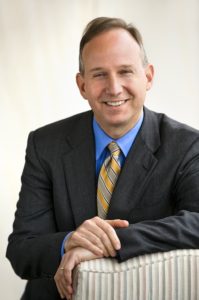
Governor Jack Markell, Delaware. Photo by Kevin Flemming.

Delaware is known for being the first state in the union and for being the second smallest. But this little state is now making a big impact for employment of people with disabilities. Putting Delawareans back to work has been one of the state’s top five initiatives since Governor Jack Markell (D) took office in 2009. And, since his appointment as 2012–13 Chair of the National Governors Association, Markell has focused specifically on increasing job opportunities for individuals with disabilities.

Maintains Markell, “State executives have the responsibility to ensure that all citizens have the opportunity for productive employment.” His A Better Bottom Line: Employing People with Disabilities initiative focuses the work of all state chief executives on developing best practices, with the goal of increasing the employment ranks of people with disabilities across the country.

Markell says, “Today, Americans with disabilities are facing disproportionately high rates of unemployment compared to those without. This impacts the old, the young and many veterans returning with disabilities.”

But the consequences of unemployment among people with disabilities goes beyond their own circumstances. “While the impact on them is direct, the impact on the rest of the country cannot be underestimated,” Markell explains. “If they are not employed, their potential contribution to the community is stymied. When they are employed, life is improved for all of us by adding their ideas and ingenuity to the improvement of the workplace and marketplace and thus increases the strength of America as an economic power.”

Origin of His Committment

It is Markell’s position that when all facets of a community work together, their efforts will benefit all. Therefore, he is committed to forging cooperation among constituents and focusing on what individuals have the potential to achieve. Within Delaware, Markell has convened meetings of educational and business leaders to engage in dialogue on how workers and businesses can best suit each other’s needs.

“The climate for business in Delaware remains positive, while at the same time charged with a passion for helping the unemployed and underemployed at all strata,” says the governor.

Markell relates the experience that led to his own passion and involvement with the cause of employment for people with disabilities. “Ten years ago I visited a Bank of America Center, a major employer in our state and an employer committed to jobs for people with disabilities,” he says. “The facility I visited was making promotional materials. I talked to a guy who was making T-shirts. He was so excited to have the job. He told me that before this job he had sat at his parents’ home for six years doing not much more than watching television. The job was such a profound improvement in his life and the life of his parents! I realized that there are a lot of other people like him and I’m committed to making a change in their lives.

“This is an issue we can really move the needle on,” the governor says, “from empty, upward to hopefully full employment.”

Efforts Yield Reuslts

How to move that needle has been a part of his agenda from the beginning. Markell’s approach brings education, business and general community members together, changing both attitudes and, more importantly, the actual number of people employed. As of 2011, two years into Markell’s term, Delaware is above the national average for employment of people with disabilities: 36 percent over a national figure of 32.6 percent. The table below illustrates the success of Markell’s efforts in Delaware.

The following information is from tables in the 2012 Annual Disability Statistics Compendium which compiles disability-related statistics. The information below comes from the Current Population Survey – Annual Social and Economic Supplement (most recent data):

Employment—Civilians with Disabilities Ages 18 to 64 Years Living in the Community for the United States and States: 2011


Employment—Civilians with Disabilities Ages 18 to 64 Years Living in the Community for the United States and States: 2011

Total Number # Employed % Employed
US 19,988,156 6,521,860 32.6
Deleware 55,773 20,051 36


Importance of National Governors Association Role

Markell hopes to make his own state’s progress an example of what the can be achieved nationally. He sees his role as National Governors Association chair as an opportunity to raise the issue to a higher level, garnering national recognition for the work being done in Delaware. Markell says, “It is our work to ask questions that bring out the needs of people with disabilities and gather best practices—about how to improve the situation.”

Recognizing that some see government bureaucracy as one such barrier, Markell maintains, “We want to spread the word about the value of such employment and work to make government a partner with business, a help and not a hindrance. We want people everywhere to focus on the ability of each job candidate, not his or her disability.”

Specifically, his initiative, A Better Bottom Line: Employing People with Disabilities spotlights the employment challenges that affect individuals with intellectual and other significant disabilities and the role both state government and businesses can play in facilitating and advancing opportunities for these individuals to be gainfully employed in the competitive labor market.

The State as a Model Employer

Markell tries to model this approach in Delaware government jobs, working toward bringing the entire spectrum of individuals with disabilities  into the workforce in the state. He says, “We anticipate the employment trend lines of people with disabilities to continue to grow, but it is difficult to determine the exact percentage from year to year. We believe our best growth will come from the new initiatives in the hires of persons with disabilities in the Delaware state government.”


Delaware Trend Numbers

FY 2010 FY 2011 FY 2012
Employment Outcomes 705 948 1020
% with Significant Disabilities 92% 94% 93%
Average Hourly Wage $9.77 $10.05 $10.39
Annualized Earnings $12.5M $15.7M $17.5M
Number Served 6,470 7,014 7,486
Employment in DE state Govt. 53 65


Future

Markell hopes that by August 2013, through the National Governors Association initiative, he will have created a blueprint for businesses and states that identifies best practices and outlines steps that can be put in place to increase economic opportunity and heighten awareness. This blueprint would provide governors and state policymakers with more policy options to assess their own states’ needs and develop specific strategies to support their populations.

Why should state leaders care about employment for people with disabilities? Says Markell, “There are so many people with disabilities who have the time, talent and desire to make meaningful contributions to interested employers. What matters is what they have to offer and the tremendous impact this will have on their overall well-being and on the bottom line of the businesses that employ them.”

Employment of people with disabilities “is the ultimate bipartisan issue,” he asserts.


Edited by Mary-Louise Piner.

Filed Under: Profiles in Excellence Leave a Comment

Tags: delaware, Jack Markell

find this post helpful? Try these:

No related posts.

share
  • « Previous Page
  • 1
  • …
  • 4
  • 5
  • 6
  • 7
  • 8
  • 9
  • Next Page »

Welcome

Whether you are interested in breaking ground in the market as a company, you are living with disability or love someone who is, we’re committed to keeping you abreast of what matters to people with disabilities—and why—so stay with us.

SIGN UP

Get the latest SMG updates in your inbox!


Categories

  • Featured
  • General
  • Notes from the Founder
  • Profiles in Excellence
  • SMG Tip
  • Video

Archives

  • March 2020
  • February 2020
  • May 2019
  • January 2019
  • November 2018
  • September 2018
  • August 2018
  • July 2018
  • May 2018
  • March 2018
  • February 2018
  • January 2018
  • December 2017
  • October 2017
  • September 2017
  • July 2017
  • May 2017
  • April 2017
  • March 2017
  • February 2017
  • January 2017
  • December 2016
  • November 2016
  • October 2016
  • September 2016
  • August 2016
  • July 2016
  • April 2016
  • March 2016
  • February 2016
  • January 2016
  • December 2015
  • November 2015
  • October 2015
  • September 2015
  • August 2015
  • July 2015
  • June 2015
  • April 2015
  • March 2015
  • February 2015
  • January 2015
  • October 2014
  • July 2014
  • January 2014
  • December 2013
  • November 2013
  • July 2013
  • June 2013
  • March 2013
  • January 2013
  • December 2012
  • October 2012
  • September 2012
  • July 2012
  • April 2012
  • December 2011
  • October 2011
  • August 2011
  • April 2011
  • February 2011

Contact Us

Quick Facts

The disability market consists of 56M people, representing an annual disposable income of $544 billion.

The disability market is more than twice as large as the tween market (20M), and has almost 3X the disposable spending power ($180B).

According to the U.S. Census Bureau, of the 69.6 million families in the U.S., 20.3 million families have at least one member with a disability.

A University of Massachusetts Boston survey found 92% of consumers felt favorably toward companies hiring people with disabilities; 87% prefer to do business with such companies.

By the year 2030, 71.5 million Baby Boomers will be over the age of 65 and demanding products, services, and environments that address their age-related physical changes.

Featured Clients

Darden Restaurants
American Express
AT&T
Sodexo
Bank of America
Wellcare
BlueCross BlueShield
ESPN
Zappos
Nike
Hilton
Get the latest SMG updates in your inbox!

678-805-7091 | info@disability-marketing.com

© 2026 Solutions Marketing Group

| a doodle dog creative website and brand