Solutions Marketing Group

Providing clients with innovative strategies that position them to understand, penetrate and retain the disability market.

  • Home
  • About
  • What We Do
  • Blog
  • Learn From Us
    • Boot Camp
    • eBook
  • Contact
  • Home
  • About
  • What We Do
  • Blog
  • Learn From Us
    • Boot Camp
    • eBook
  • Contact

Dreams, Hugs, Achievements

January 15, 2013

Wouldn’t it be great if you knew a place with delicious meals for breakfast and lunch, accompanied by the best hugs in town? And better still if you knew your eating-out dollars were going to a worthy cause, like supporting a person who has overcome his disability and inspires people to achieve their own dreams?  If you’re in Albuquerque, you can have all this at Tim’s Place.
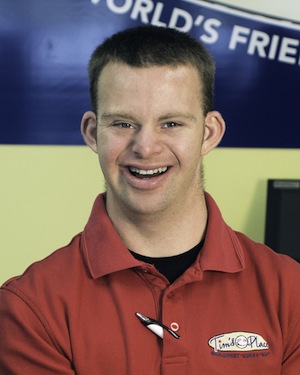
Tim HarrisOwning Tim’s Place is a dream come true for Tim Harris, a young man with Down Syndrome. As manager of the restaurant, Harris puts into practice what he learned while in college studying food service and restaurant hosting. He also continues a rewarding career that he started while working at many different restaurants during high school, college and after college. The restaurant also allows him to also give back to the community as an employer and a sponsor of Special Olympics and the National Down Syndrome Congress.

It All Starts at Home

For Harris, making the dream a reality began with a loving and supportive family. His abilities were further nurtured in a school that recognized his talents and allowed him to develop in sports as well as academics. Says Harris, “Growing up, I always knew that [my family] loved me just the way I am. My brothers treated me like a brother, not like anyone special.” Tim is the second in a family of four sons.

He adds, “My brothers tried to let me do things for myself. Sometimes they let me hang out with them and their friends, but other times they wanted me to hang out with my own friends.” As with any siblings, this kind of close relationship, mixed with times of independence, helped Tim to develop strong interpersonal skills.

Although his brothers no longer work at Tim’s Place like they did in the beginning, the fraternal bonds continue to this day. “We are a very close family,” he says. “We like to travel together, go out to eat, play games and sometimes I like to go to parties at my brothers’ houses. I always know they are there for me when I need them.”

This close relationship at home bolstered Harris’ confidence and helped contribute to his success in school. Harris attended Eldorado High School in Albuquerque and was graduated in 2004. His enrollment and that of some peers encouraged P.E. teacher Michelle Chavez to add Special Olympics to the curriculum. The Special Olympics team during Harris’ high school career was the Eldorado’s first, Harris relates. He helped make it a success, winning medals in several categories.

Special Olympics

Tim poses with his medals from the 2012 Special Olympics

Tim poses proudly with his medals from the 2012 Special Olympics New Mexico Summer Games.

Harris played poly hockey*, volleyball, and track and field for his high school Special Olympics team, but it was his responsibilities as captain of the basketball team that gave him an extra opportunity to shine. This role proved beneficial for Harris’ future as a business owner and manager. “My coach , Ms. Chavez, taught me about being a leader,” says Harris. “I had to make sure my team did all their warmups and introduced them at our school assemblies. Ms. Chavez was very tough and taught me a lot about being responsible for my other teammates. I think everyone at my school was proud of their Special Olympics athletes.”

It may come as a surprise to some that high schools can field Special Olympics teams but, explains Erin Gallegos of New Mexico Special Olympics, “the high school Special Olympics program in New Mexico is available to any school that wants to take advantage of it. Athletes up to age 21 enrolled at the school can participate. However, high school programs are not as common as community-based programs in New Mexico.”

Harris’ high school achievements were not limited to the athletic field. He was also named Homecoming King and selected by students, staff and faculty as Student of the Year when he graduated in 2004. He accomplished all this while working after school in a local Red Robin franchise, where he first realized his love of working in the restaurant industry.

Making a Dream a Reality

With help from his dad, Harris found a postsecondary program at Eastern  New Mexico University at Roswell that would suit his career goals. “I knew I wanted to be in the restaurant business and chose to study food service and restaurant hosting,” he says. “Eastern  New Mexico had a program to help students learn the rules,” he relates. While a student, Harris worked at a variety of local restaurants including CiCi’s Pizza, Golden Corral, IHOP, and Peppers Bar and Grill.
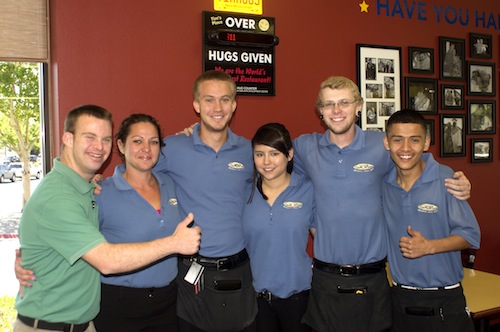
Tim Harris and Tim's place employees

Tim (left) posses with Tim’s Place employees.

Harris stresses that in order to live on his own, he had to know how to keep a schedule and be on time, but these skills were already familiar to him. He also had to do his own laundry and clean up after himself—which he’d also already done while living at home. He notes that friends of his who did not really want to be in college or who weren’t as prepared to be independent were not as successful.

“My experience in college was fun,” Harris relates. “I made good friends that I will always stay in contact with. I was scared at first, but I decided to join in, make friends and work hard.” His dedication to his goal helped him succeed as well. “I wanted to own a restaurant when I was a kid,” he relates. “That was my dream and dreams come true.”

After graduating college in 2008, Harris worked as a host at Applebee’s restaurant in Albuquerque and then, living aboard a sailboat with his parents, he traveled throughout the Bahamas, where he first earned his nickname “Tim the Man.” When the family returned, Harris was ready to work again, and his parents were ready to help finance his employment dream of having his own restaurant.
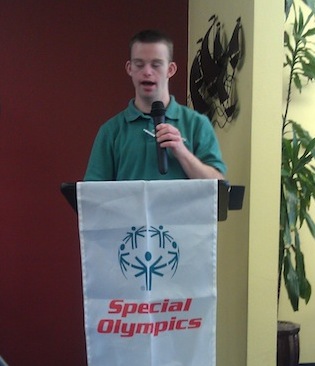
Tim Harris speaking as a Special Olympics Global Messenger.

Tim Harris speaking as a Special Olympics Global Messenger.

Although at present there are no other people with disabilities working in the restaurant, Harris hopes to hire some in the future.  In addition to offering delicious food and free hugs seven days a week, the restaurant also supports Special Olympics of New Mexico and the National Down Syndrome Congress.

And, when he’s not at the restaurant, Harris is a popular speaker on the topic of achievements for people with disabilities. Anyone who talks to Harris can easily see why people seek out his public-speaking presentations. His positive attitude and desire to help others come through immediately. His love of his family comes through as well. For example, in conversation for this article, Harris was bursting with pride at the fact that  his brother had just graduated and became an Albuquerque firefighter. He can be reached through his speaker website, http://timtheman.com. Or you can check out the food, hugs, and positivity on the menu at Tim’s Place.
 

*Poly hockey is adapted from the game of ice hockey. It’s an indoor floor sport that gives athletes who live in warm climates the opportunity to compete in the normally winter sport of hockey. Poly hockey once was, but is no longer, a recognized Special Olympics Incorporated sport as is floor hockey, which is played with wooden sticks (without blades) and pucks that are large felt discs with an open center.

Filed Under: Profiles in Excellence Leave a Comment

Tags: disability employment, Down syndrome, self-employment, special olympics, Tim Harris, Tim's Place

find this post helpful? Try these:

Randy and Austin LewisDoing Good is Good Business Ford logoFord: Innovation from the Inside Out
share

Museum of disABILITY History: Museum as Public Forum

December 1, 2012

By Joan Leotta

Museum of Disability HistoryWhat’s one of the best ways to have fun while learning history? Museums around the country champion history through various lenses, from the stalwart Smithsonian museums in Washington, D.C. to smaller venues that showcase more targeted segments of human history. The disability community now has a museum—complete with traveling exhibits and featuring an ever-growing robust online presence—to call its own.
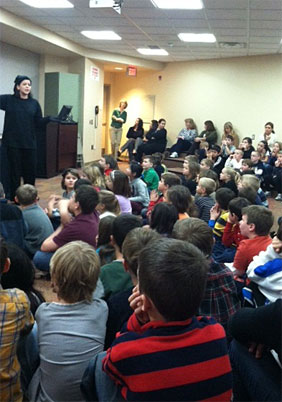
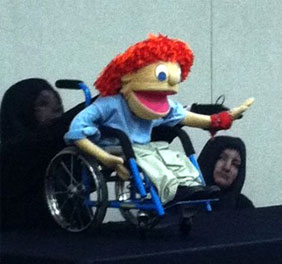

The Museum of disABILITY History in Buffalo is much more than a collection of exhibits and impressive library of achievements of people with disabilities. In addition to documenting the role that people with disabilities have played in American history, the Museum reaches out across the country to benefit employment, social acceptance, and advocacy for people with disabilities. Through its Web site, museumofdisability.org, people from around the world can view virtual exhibits and inquire about arrangements to have traveling exhibits to come to their localities.

Purpose of the museum

Dr. James Boles, President and CEO of the institution’s parent organization People Inc., founded the Museum in 1998. At the time, Dr. Boles was teaching a Disability Studies course at the University at Buffalo and looking for a disability-history perspective that highlighted archival and library collections. “When he found there were no museums or libraries dedicated to this topic,” says Theresa Fraser, current Museum Director, “he chose to start the Museum of disABILITY History.”

The Museum was a natural fit for People Inc., the non-profit, which started in 1970 to address the needs of individuals with intellectual disabilities, expanded from a small grassroots organization of parents and professionals to include a wider variety of services to address the needs of people with developmental disabilities and disabling conditions in many geographic locations and numerous sites.

The primary mission of the Museum is to advance understanding, acceptance, and independence of people with disabilities. The museum’s collections, archives and educational programs create awareness and a platform for dialogue and discovery. “We started as a small traveling exhibit and grew gradually,” explains Fraser, “moving to our current location in October of 2010.”

Brie Kishel with students

Brie Kishel, education coordinator, prepares students to learn about disABILITY awareness from the “Kids on the Block of WNY.”

The museum’s adept use of social media such as Facebook and Twitter allows the institution to act as an advocate for people with disabilities. For example, through the Museum’s Facebook page staffers weighed in to decry outspoken Republican pundit Ann Coulter’s disparaging use of the term “retarded” during the 2012 presidential campaign. The Museum became an active participant in the dialogue over this term and advocated for its constituency by posting a rejoinder written by a girl with Down syndrome. Such posts also serve to raise the awareness of the general public toward people with disabilities.

More than a Job

Working at the Museum is more than simply a job for Fraser. She says, “My role as Director of the Museum combines all of my passions in life.

“Having had a family member with a disability and having worked for People Inc. for five years prior to coming to the Museum, I have always been connected to disability,” Frasier explains. “I received my Masters Degree in Library Science from the University of Buffalo in 2006 and wanted to focus on rare and specialized collections.” Finding a job at the Museum put her skills and her passions together. “Being able to combine my experience and education in my current role have been incredibly rewarding and fulfilling,” she says.

Brie Kishel, the Museum’s Education Coordinator, brings a certain zeal to her job as well. Her association with the Museum began through Kids on the Block of Western New York, another People Inc. venture. Kids on the Block originated as a puppet show featuring characters with disabilities during the push for mainstreaming in the mid-1970s, providing children a comfortable environment to discuss questions or concerns they might have about their peers. An international program with 1,700 troops worldwide, Kids on the Block is now an educational outreach program of the Museum and one of the several responsibilities under Kishel’s purview as Education Coordinator.

Programs for All Ages

In addition to Kids on the Block, which is geared toward third graders, the Museum approaches other age levels with appropriate types of learning experiences. “Curriculums have been developed for each grade level, along with an accompanying annotated bibliography providing additional literary resources,” Kishel explains. “For example, for K–2, we offer ‘Reading with a Puppet’ programs, which incorporate a trained puppeteer using the character to read a book about accepting differences and facilitating a discussion geared towards encouraging students to celebrate their own differences and those which they see in others.”

For grades five and six, the Museum offers Disability Etiquette Program seminars, available for presentations at schools or other localities. Lesson plans for older children, grades seven through twelve, are also available for download from the online Museum. These feature topics designed to hook young interests, such as the successes and achievements of athletes, actors, and musicians with disabilities. Starting in 2013, a program in conjunction with “Dignity for All Students Act” will focus on prevention of bullying.

Mark Riley talking to students

At a Kids on the Block of WNY event, Mark Riley talks to students at Parkdale Elementary in East Aurora, NY about what it’s like to have cerebral palsy.

The Museum also offers other outreach efforts aimed at the community at large, such as a recent presentation entitled “Changing Paradigms form Accessibility to Universal Design,” held in cooperation with the University at Buffalo School of Architecture and Planning.

Fraser adds, “We are very lucky to partner with the University at Buffalo Center for Disability Studies right here where the museum is located. The Director of the Center, Dr. Michael Rembis, serves on our exhibit development committee and consults with us on various projects throughout the year.”

Even without a particular program, the online museum provides educational opportunities. “Our virtual, online museum offers a wealth of educational resources and tools that can be utilized in teaching younger students up to and including those at the college level,” says Kishel.

Expanding the Reach and Assessing Impact

Although many of the live outreach programs are generally only available in Western New York, the virtual museum opens the benefits of these programs to national and international audiences as well.

Another way to expand the reach of the museum is as a model for best employment practices for people with disabilities. Through People Inc.’s People through Services program, the Museum employs a number of part-time employees with disabilities. Fraser says, “We currently have three individuals through this program. They perform various duties, currently they are serving as docent museum tour guides, working in the catalog area, and assisting with several Boy Scout and Girl Scout programs.

Fraser concludes, “Our mission has always been and will continue to be to promote education and awareness, in order to play an active role in advocating for individuals with disabilities and helping to create a more accepting society.”

Visiting Online or in Person

Museum of DisABILITY History
www.museumofdisability.org
store.museumofdisability.org
3826 Main Street
Buffalo New York 14226
Phone (716) 629-3626
info@museumofdisability.org

Hours:
Tuesday – Friday 10:00 am – 4:00 pm
Saturday 10:00 am – 2:00 pm
Other museum hours can be scheduled upon request. Group tours are also available. Please contact info@museumofdisability.org

The Museum is a non-profit organization with a nominal admission fee:
$5.00 – Adults
$2.50 – Students, seniors, and Human Service Employees
$2.00 – Children ages 6-17
Free – Children 5 and under


Edited by Mary-Louise Piner.

Filed Under: Profiles in Excellence Leave a Comment

Tags: museum of disability history

find this post helpful? Try these:

No related posts.

share

CertifiKid: Special Deals for Special Needs

October 1, 2012

By Joan Leotta

CertifiKid logoBargains! They’re the clarion call of every shopper. The Internet has become an ideal platform for finding discounts on a multitude of goods and services. Although there were already many services offering deals and online coupons in the Washington DC metro area, Jamie Ratner, a Bethesda, Maryland mom and author of a popular blog on bargains for families, saw an unserved niche: She noticed that most deals offered on websites such as Groupon and Living Social were primarily aimed at young singles.
The idea for her website, www.certifikid.com, came to fruition when Ratner realized that she could make her wish for more coupons and services for families a reality. Her company was one of the first to provide deals on a variety of family-friendly items and services including amusement park visits, summer camps and more. And from the beginning, she also identified a more targeted grouping of families who might love coupons: those with special needs kids.

Jamie’s sister, a teacher of students with special needs, along with friend Sunday Stilwell, a popular DC/Baltimore area blogger, influenced Jamie’s decision to expand into this area. The disability deals are an option available in each city where CertifiKid has a presence. From the homepage, readers can find a “Special Deals for Special Needs” icon along the right-side column that leads to www.certifikid.com/special_needs.

What CertifiKid has to offer

CertifiKid works by offering subscriber families limited-time deals on local goods and adventures. The site aims to be, according to its “About” page, “an online playground for families to build relationships with each other and local businesses that will last beyond the initial transaction.” Once customers find and purchase a deal through the site, they can print out an exclusive coupon to be redeemed at the business. Other deals are also available at CertifiKid’s Facebook page and through Twitter. Families who refer others to CertifiKid.com receive referral credit through the site.

Ratner and her crew connect with their target market because they are the target market. Ratner, a mother of two living in a high-cost area, understood her market well—families with children, looking for a way to stretch their dollars and still enjoy activities together as a family. The site’s tagline, “Your playground for great family values,” emphasizes this search for family-fun activities at bargain prices.

Since its 2010 launch in DC, the coupon site already operates in six East-Coast cities. A May 2010 article in the Maryland Gazette quoted Ratner on the early progress of the company, indicating that the site garnered 1,200 subscribers and eight purchases on its first day alone. Speaking to SMG in July 2012, Lara DiPaola, CertifiKid Marketing Director, said that the company had 10,000 subscribers to the special needs portion of the site alone.

Why “Special Deals for Special Needs”?

CertifiKid is the first deal site to offer bargains focused on families of children with special needs. “’Every family deserves a deal’ is Jamie’s philosophy, so she immediately expanded into that direction,” says DiPaola. “When you go to that area of the site or when you click the ‘Special Deals for Special Needs’ logo on the site, you are prompted to sign up for a free account and then you will receive an email each time we have a new deal to offer.”

Bargains on the special needs area include general-interest items like amusement park tickets and moonbounce rentals but also feature deals such as 50% off for individual education plans (IEPs) and occupational therapy services and products designed specifically for special needs. While of course, many public school jurisdictions offer IEPs as a free service, the “for pay” IEP can be of help to a home schooling parent, those sending children to private schools that may not pay, and anyone wanting a second opinion on the public school IEP,

DiPaola explains, “What we want to achieve by creating the Special Deals for Special Needs site is more than simply bargains. We hope to achieve inclusion.

“So many people use that word when referring to this community,” she continues. “We want to make it a real, tangible thing. When Jamie founded the company it was because she didn’t see the needs of families being met. With Special Deals for Special Needs we are simply taking that and doing our best to be sure that all families can benefit from a great deal.”

She adds that sometimes the special needs portion of the site may not have offers as are available on the main sight. “The number of offers ebbs and flows. My advice is to check frequently. There is no charge to families to be a part of our community either on the site or in our active social media outlets.”

Expansion and honors

The CertifiKid program already offers deals in the Washington DC metro area, Baltimore, Pittsburgh, Philadelphia, Delaware, and Hampton Roads, Virginia. Says DiPaola, “We already consider ourselves national because we help introduce businesses all over the country to families in the cities we are in right now. We plan to expand, but we’ll do that slowly, taking time to focus on building the right team in each new market that is key for us.”

Media coverage and opportunities have been key to spreading the word about the site. CertifiKid was recently recognized as the “Best Deal Site for Parents” by Washingtonianmagazine. Their CEO was named one of the top 40 under 40 Business Leaders by the Washington Business Journal in 2011. Additionally, in August 2012, founder Ratner was a featured speaker at The Power Conference: Women Doing Business in the DC area.

DiPaola says that the company measures success not necessarily by numbers of subscribers but by connections made. “Every time we get an email or see a post on Facebook that says that a family used a deal and loved it, that is success,” she asserts. “It’s something you have to work to take care of every day.”

How do they approach that task? “We do things differently from most deal sites,” she says. “We don’t have call centers or huge marketing teams. We like to keep it local, employ other parents, and be a part of the community. When we’ve been able to do that in every city, everywhere—that will feel like success.”


Edited by Mary-Louise Piner.

Filed Under: Profiles in Excellence Leave a Comment

Tags: CertifiKid, families, shopping

find this post helpful? Try these:

A Caroline Cart from TargetFree to Shop: TARGET’S Adoption of Caroline’s Carts Heralds a New Era in Inclusion
share

Take the Stage, Take the World: Theater Breaking Through Barriers

September 1, 2012

A character from William Shakespeare’s As You Like It famously states, “All the world’s a stage!” Ike Schambelan, artistic director of Theater Breaking Through Barriers (TBTB), expands on that quote to declare, “The stage is the way to change the world!”

Actors Shannon DeVido and David Marcus

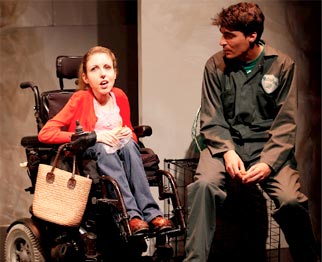
Shannon DeVido (Melanie) and David Marcus (Ben) in Samuel D. Hunter’s “Geese,” part of TBTB’s MORE OF OUR PARTS. Photo by Carol Rosegg.

How? As he explains, “Theater leads the way to bringing people into the mainstream.” He notes that although “thirty percent of all families have someone with a disability…we still need to bring disability into the mainstream. Theater does that. It gets the conversation going.”

TBTB (www.tbtb.org), a theater company funded by multiple sources, works for social change in the heart of New York City’s Theater Row. It is the only multiple-disability presence on the Off Broadway stage in New York at present. Although Schambelan founded TBTB in 1980 as the Theater of the Blind, four years ago the theater broadened its scope to include all disabilities. He says, “There are other good companies coming up.”

What does Theater Breaking Through Barriers do? According to its mission statement, TBTB is “dedicated to advancing actors and writers with disabilities and changing the image of people with disabilities from dependence to independence.” This is accomplished not only through the hiring and prominent inclusion of actors and writers with disabilities to work in off-Broadway productions, but also through a 10-Minute Play Festival of commissioned plays about disability.

10-Minute Play Festival

actors Joshua Eber and Shawn Elliott

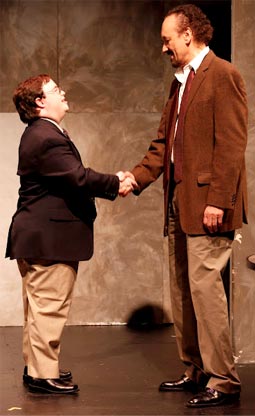
Joshua Eber (Lewis) and Shawn Elliott (Eli) in Jeffrey Sweet’s “A Little Family Time,” part of TBTB’s MORE OF OUR PARTS. Photo by Carol Rosegg.

The idea of the 10-Minute Play Festival came from Beth Blickers, TBTB board Chair. Schambelan notes, “Being in New York gives us access to some of the best actors, directors and writers in the world.” Last year he put that mix of potential talent to the test by soliciting ten-minute plays from a variety of writers for a festival called Some of our Parts. He explains, “We chose the ten-minute play format because it is easier to get someone to write that size play for you.”

Last year’s inaugural festival showcased the work of seven writers whom theNew York Times reviewers called “an intriguing group of established and emerging playwrights”: Bekah Brunstetter, Samuel D. Hunter, Neil LaBute, Kate Moira Ryan, Diana Son, Jeff Tabnik and Emily Chadick Weiss. Fourteen actors, many with disabilities, displayed their talents for the 2011 production at the Clurman Theatre on W 42nd Street.

This year, TBTB’s More of our Parts, the second installment of the festival, ran from June 20 to July 1 and featured a new set of shorts, several by the same playwrights who wrote for the 2011 production. This time, Schambelan solicited scripts from other sources as well, reaching out to include new and younger writers. He says that although “two writers with disabilities said ‘no’ to me this year, [they] promised scripts for the future.” New to TBTB this year were playwrights Bruce Graham, A. R. Guerney and Jeffrey Sweet.

More of our Parts had lots of positive critical response and showcased 13 terrific actors, according to Schambelan. The Times said it was an “entertaining and worthwhile 70 minutes, witty and potent.” New York Theater Buying Guide said, “Our highest recommendation–don’t miss this dazzling package of one-acts by outstanding playwrights, delivered by an enormously talented creative team.”

Reaching out

Actors Nicholas Viselli and Shawn Randall

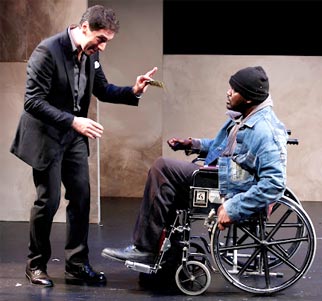
Nicholas Viselli (Guy) and Shawn Randall (Homeless Dude) in Neil LaBute’s “The Wager,” part of TBTB’s MORE OF OUR PARTS. Photo by Carol Rosegg.

In 2011, TBTB took several of that year’s ten-minute plays to a festival in Croatia. Actors from Britain and Croatia did small parts in the shows, extending the reach of the festival’s work to an international audience.

Word about this year’s festival reached the Kennedy Center in Washington D.C., leading Betty Siegel, the Director of the Kennedy Center’s VSA and Accessibility Office, to invite the company to perform. “The Kennedy Center is always looking for dynamic and exciting new work by performing artists with disabilities or featuring issues relevant to the disability community,” says Siegel. “I’ve known of TBTB for a long time, and their 10-Minute Play Festival is something new and interesting.”

She explains the festival’s appeal like this: “They have gotten well-known playwrights, some with and some without disabilities, to write on a disability issue/theme/topic and produce those by casting actors with and without disabilities. This makes for the kind of engagement with the disability community and the theater community that I find really energizing. So, this seemed to be the right time to collaborate with TBTB to bring this work to DC. We wanted to produce something to celebrate the ADA anniversary.”

TBTB More of our Parts performance was held on July 24 on the Millennium Stage, a Kennedy-Center venue whose core philosophy is: the arts are for everyone. Performances there are free and some, like the TBTB production, are streamed live online.

Schambelan thinks that the Kennedy-Center appearance will promote even more positive inclusion for people with disabilities. He says, “We have been getting a lot of additional interest in the company…. I think that we have the Kennedy Center to thank for that.”

He points out that, as disabled playwright John Belluso once said, “disability is the only minority that anyone can join at any time.” Fear of this possibility is what often keeps others from accepting people with disabilities. Schambelan notes, “It is the mission of [our] theater to decrease this fear by showing the exuberance and independence, as well as the challenges, of lives lived with disability. The potential of this mission is the great source of power for us; power for change and inclusion.”

Schambelan hopes to build on the momentum of the 10-Minute Play Festival series by getting some of the plays published and enticing companies across America to produce them. He explains, “We believe that through artistic excellence and the development of role models we can best make our claim for full inclusion of people with disabilities in our society.”

Siegel agrees that the work of TBTB and theater in general has an important role to play in changing perceptions of people with disabilities in society. She says, “Theater is a wonderful way to look at the world around you. I love theater because I can experience other people’s stories perspectives and worlds. I think that is what the arts do well—help us understand ourselves, one another and the world around us. The Kennedy Center really strives to include all people with and without disabilities in the art that we do and hopefully, our audiences get the message that we are a wonderful and diverse country with so many different people with so many different and amazing talents.”

Edited by Mary-Louise Piner.

Filed Under: Profiles in Excellence Leave a Comment

Tags: acting, actors with disabilities, theater, Theater Breaking Through Barriers

find this post helpful? Try these:

No related posts.

share

ReelAbilities: Using Film to Change Perceptions and Realities

July 15, 2012

By Joan Leotta

Reel Abilities Film Festival LogoAction. Adventure. Romance. Success against all odds. These are some of the draws of a good movie. Compelling movies make viewers think, invite conversation or debate, and can even change minds and hearts. With all of this in mind, some New York City cinema devotees decided to establish a traveling film festival highlighting stories and inspirations of people with disabilities from around the world.

The “largest festival in the country dedicated to promoting awareness and appreciation of…people with different disabilities,” the ReelAbilities Film Festival  offers post-screening discussions that encourage viewers to, according to the Festival’s mission statement, “explore, discuss, embrace, and celebrate the diversity of our shared human experience.” This chance to consider the insights and possibilities presented in the films helps to reinforce positive images of people with disabilities in society.

Development of the Festival

“Film as dream, film as music. No art passes our conscience in the way film does and goes directly to our feelings, deep down into the dark corners of our souls.”
Ingmar Bergman

The ReelAbilities Film Festival began as an offshoot of projects at the Jewish Community Center in Manhattan. Festival Director Isaac Zablocki says, “We use film to create change here at the Center. I was getting some fabulous films on disabilities.” Anita Altman, founder of the UJA (United Jewish Appeal) Federation’s Task Force on People with Disabilities, had connections in the disability community. “She really made [the Festival] happen,” says Zablocki.

Together with Altman, Zablocki was able to present the first screenings in September 2008 in New York. The founding vision contained the elements that still define the Festival: Powerful international films, multiple venues in a host city, and lively discussions to follow each showing.

Zablocki notes that “although the Festival is headquartered in the JCC in Manhattan, it is not a Jewish festival.” Rather, the event spotlights “films from all over the world centered on people with disabilities.” This year’s New York films included such diverse offerings as:

  • Run If You Can, a German story of friendship and love among Ben, a wheelchair user; Christian, his caretaker; and Annika, who cannot decide between the two France’s
  • The Straight Line, about a young runner whose emerging blindness does not prevent him from finding love and athletic success
  • Defining Beauty: Ms Wheelchair America, a tale of the paths five women take to the Ms. Wheelchair America pageant
  • Mabul (“The Flood”), produced in Israel, a coming-of-age drama about a family whose eldest son, an autistic, returns from spending years in an institution

The 2012 New York festival featured 16 films shown at 23 different venues across the New York area, reaching over 6,000 viewers. Other cities to feature ReelAbilities Film Festivals include Atlanta, Cincinnati, Chicago, and Washington, DC. More than 65 groups partnered to support the New York Festival, with funding for the traveling programs coming from the Saul B. Schottenstein Foundation. The Schottenstein contributes to the Festival because it “celebrates the oneness of humanity,” says Zablocki.

Choosing the best

Any form of art is a form of power; it has impact. It can affect change. It cannot only move us, it can make us move.
Ossie Davis

Zablocki notes that the selection criteria and structure of the festival have helped contribute to its success. “We want quality films that portray people with disabilities against stereotype,” he explains. Movies are selected by a committee that comprises both members on the Festival Board and people from disability communities. Ravit Turjeman, Festival Co-Director, says, “When we get a film that confronts an issue or deals with a disability where we do not have expertise on the committee that year, we reach out to that disability community for advice.” The committee attempts to present a variety of films, balancing offerings for length and for type of disability.

The Festival has had no trouble attracting high quality films from all over the world. About 200 were submitted to fill the 16 slots for the 2012 Festival. The films ranged in length from just a few minutes to full-length features of up to two hours. Many of these films had won awards in other festivals. “We do not require that a film premiere here,” says Zablocki, “but we do request that the distribution was somewhat limited before entering it in our Festival.”

Measuring Success

Because Turjeman’s background includes marketing, programming, and film distribution, she knows the importance of making connections, both by promoting films among interested communities and through the face-to-face relationships established in the receptions held after the showings. For instance, because My Spectacular Theater, a feature from China, showcased the story of a blind person, the Festival team sent out information about the film throughout the local Asian-American community. Some other movies hold inherent widespread appeal, such as last year’s Warrior Champions about four Iraq War veterans who, after losing limbs and suffering paralysis fighting for their country in Iraq, set out to turn the nightmares of war into Olympic dreams.

“Does art reflect life? In movies, yes. Because more than any other art form, films have been a mirror held up to society’s porous face.”
Marjorie Rosen

Perhaps the most powerful connections that the Festival makes come through the discussion sessions that bring together audience members and, in many cases, the actors and artists behind the original films. Turjeman notes, “Our audience members might be employers or leaders in the community. After meeting the people who make the films, those who act in the films, and the people with disabilities who are at the show, their attitudes change and they are more willing to interact with people with disabilities and hopefully, to hire them.”

Festival coordinators also measure success with post-screening questionnaires. Turjeman explains, “We survey the audience after each screening and also collect and record anecdotal evidence and comments to determine the impact of the festival on those outside of the disability community and on people with disabilities.”

The survey asks audience members to rate the screening experience in three categories: the film itself, the discussion, and accessibility. The survey also asks whether the film viewing changed the audience member’s perception of people with disabilities. The figures for this year’s New York Festival reveal that 96 percent of the audience members indicated that the festival helped influence their perceptions of people with disabilities. The Festival achieved a score of 4.6 (out of 5) for quality of discussions and for accessibility.

Turjeman indicates that, “so far the results show that perceptions are being changed in our/the community.” These positive perceptions are spreading widely. As a result of the Festival, “people with disabilities are enjoying an improved self image,” she continues. “Our results show that they are being filled with pride and that the Festival reinforces the idea that they have no limits.”

The recent New York Festival offered tangible proof of that positive spirit. “The last showing in New York fell on Valentine’s Day, so we held a dance after the screening,” says Turjeman. “During the dance a woman came up to Ariana Cohen-Halberstam, Festival Program Associate and asked if she had a camera. The woman wanted to take a picture of her 18-year-old daughter who was out on the floor, dancing. She told us, ‘My daughter has never danced with a boy before!’”

ReelAbilities does not offer awards to the films that enter. “We feel that the selection is honor enough,” says Zablocki. “In the four years it’s been held, the Festival has grown into one of our proudest achievements.”

Accessibility

Ever since the beginning, Festival organizers of course recognized the importance of making the Festival accessible to any and all attendees. Each venue guarantees wheelchair accessibility and captioning for all films. ASL interpretation, CART (Communication Access Realtime Translation for the deaf), Live Audio Description, and information in Braille are all available upon advance request. In addition, the Festival committee works hard to select Festival dates that can provide accessibility in any kind of weather while avoiding other major film festival dates. The 2013 New York Festival is set for March 12-17.

Filed Under: Profiles in Excellence Leave a Comment

Tags: ReelAbilities Film Festival

find this post helpful? Try these:

No related posts.

share
  • « Previous Page
  • 1
  • …
  • 5
  • 6
  • 7
  • 8
  • 9
  • Next Page »

Welcome

Whether you are interested in breaking ground in the market as a company, you are living with disability or love someone who is, we’re committed to keeping you abreast of what matters to people with disabilities—and why—so stay with us.

SIGN UP

Get the latest SMG updates in your inbox!


Categories

  • Featured
  • General
  • Notes from the Founder
  • Profiles in Excellence
  • SMG Tip
  • Video

Archives

  • March 2020
  • February 2020
  • May 2019
  • January 2019
  • November 2018
  • September 2018
  • August 2018
  • July 2018
  • May 2018
  • March 2018
  • February 2018
  • January 2018
  • December 2017
  • October 2017
  • September 2017
  • July 2017
  • May 2017
  • April 2017
  • March 2017
  • February 2017
  • January 2017
  • December 2016
  • November 2016
  • October 2016
  • September 2016
  • August 2016
  • July 2016
  • April 2016
  • March 2016
  • February 2016
  • January 2016
  • December 2015
  • November 2015
  • October 2015
  • September 2015
  • August 2015
  • July 2015
  • June 2015
  • April 2015
  • March 2015
  • February 2015
  • January 2015
  • October 2014
  • July 2014
  • January 2014
  • December 2013
  • November 2013
  • July 2013
  • June 2013
  • March 2013
  • January 2013
  • December 2012
  • October 2012
  • September 2012
  • July 2012
  • April 2012
  • December 2011
  • October 2011
  • August 2011
  • April 2011
  • February 2011

Contact Us

Quick Facts

The disability market consists of 56M people, representing an annual disposable income of $544 billion.

The disability market is more than twice as large as the tween market (20M), and has almost 3X the disposable spending power ($180B).

According to the U.S. Census Bureau, of the 69.6 million families in the U.S., 20.3 million families have at least one member with a disability.

A University of Massachusetts Boston survey found 92% of consumers felt favorably toward companies hiring people with disabilities; 87% prefer to do business with such companies.

By the year 2030, 71.5 million Baby Boomers will be over the age of 65 and demanding products, services, and environments that address their age-related physical changes.

Featured Clients

Darden Restaurants
American Express
AT&T
Sodexo
Bank of America
Wellcare
BlueCross BlueShield
ESPN
Zappos
Nike
Hilton
Get the latest SMG updates in your inbox!

678-805-7091 | info@disability-marketing.com

© 2026 Solutions Marketing Group

| a doodle dog creative website and brand