Solutions Marketing Group

Providing clients with innovative strategies that position them to understand, penetrate and retain the disability market.

  • Home
  • About
  • What We Do
  • Blog
  • Learn From Us
    • Boot Camp
    • eBook
  • Contact
  • Home
  • About
  • What We Do
  • Blog
  • Learn From Us
    • Boot Camp
    • eBook
  • Contact

Featured Posts:

SMG March 2020 Update

A Letter from the Founder: How to Reach Consumers with Disabilities

A Letter from the Founder: How to Reach Consumers with Disabilities

Spring Update from Carmen!

Spring Update from Carmen!

SMG Tip: Understanding the Market

January 13, 2015

The disability market is the largest untapped group of consumers in the United States, comprised of 56 million people and represents an annual disposable income of $544 billion. The disability market is more than twice as large as the tween market (20 million), and has almost 3 times the disposable spending power ($180 billion).

The facts alone are not enough.  Many companies know they should do more to reach the disability marketing, but few take decisive action. Successful companies know that in order to reach consumers with disabilities and their influencers, it’s important to understand what drives them.  What are their needs? How to communicate in ways that resonate with them? And, how can a company build a relationship that inspires the know/like/trust factor?

The Solutions Marketing Group (SMG) has completed extensive research for companies in various sectors and has discovered a few things to jumpstart disability marketing for companies.  Among the things we’ve learned are:

  1. Most people with disabilities receive and trust information on products and services from peers, conferences and disability organizations. The power of an endorsement coming from a trusted source is strong. If your company has built relationships with disability organizations, begin to identify the one/s that have programs or services that align with your company’s mission and explore opportunities to attend events, or add value at their conferences with workshops that enhance the lives of the people they serve.
  2. Peer review of products is preferred over solely receiving advertisements from a company.  Word of mouth for the market is THE most trusted way to reach them.  Determine how your product/service be experienced by ‘influencers’ so they can share their experience with their peers?
  3. Consumers want companies to demonstrate a meaningful commitment to the disability community by employing people, strengthening the buying experience, and placing products and information in an easy-to-find format.  How can your company tell its story so it resonates with consumers? This goes a long way to build credibility.
  4. People with disabilities want to be able to interact with the product or service before making a purchase. As your team plans its 2015 outreach calendar, what disability events can be integrated into the schedule so consumers can see and touch your products?
  5. When possible, promote products and services in a staggered manner – regionally, statewide and nationally.  The SMG Team has found that repeated, consistent resonant messaging that is focused in approach allows consumers to understand corporate commitment to them, and lays a solid foundation for building trust.  This approach provides companies with the ability to test and refine messaging and tactics, creating a win-win.

If you’d like to learn more about how to understand the disability market, contact the SMG Team for a 30-minute free call to gain further insights.


Filed Under: SMG Tip Leave a Comment

find this post helpful? Try these:

No related posts.

share

SMG Tip: Everything rises and falls on leadership

October 28, 2014

illustration of three people walking up stairs. the woman in front is holding a flag, leading the other two people up the stairs.

Author and leadership expert John Maxwell has said, “Everything rises and falls on leadership.” This maxim holds true when companies are positioning themselves to recruit and market to people with disabilities.  Companies at the forefront of disability inclusion have exemplified strong executive leadership and support, and do the following:

  • Complete an internal assessment that identifies gaps in employment, customer service, and marketing;
  • Obtain support and commitment from executives who understand the business impact of reaching the market;
  • Provide resources (staff and budget) to support disability employment, customer service and marketing;

Without executive leadership commitment targeting the disability market will lack strength and is almost always overtaken by other priorities. The most successful organizations have a C-suite leader, who is an influencer and is engaged.  

Often, leaders like yourselves are the catalyst for disability inclusion. To make progress it’s really important for you and your team to have an honest discussion to assess where you are, where you want to be and identify the ways your organization can close gaps.  A few questions to consider are:

  • Who is your customer or employee with a disability?
  • How will you reach them?
  • What are the biggest challenges your prospective employee or consumer faces when interacting with your organization?
  • How can your organization help prospective employees or consumers achieve their goals?
  • How can your organization help prospective employees or consumers overcome challenges?
  • What are your internal stakeholder’s biggest objections about disability marketing, employment and customer service?
  • How can you overcome objections?

Answering these questions begins the process of integrating disability inclusion within your organization.

Filed Under: SMG Tip Leave a Comment

Tags: disability employment, leadership, recruitment

find this post helpful? Try these:

No related posts.

share

“Fit Is Our Superpower”: JCPenney

October 1, 2014

By Joan Leotta

What does it take to make an item of clothing feel like a good fit? Whether your priorities are comfort, shape, or style, clothes that fit make you feel good about yourself. For more than 100 years, JCPenney has been striving to serve customers who have a wide variety of sizes, incomes, and body types. The company’s most recent advertising campaign is a salute to the value of shoppers with disabilities and otherwise unconventional bodies: the promise of a good fit for everyone.

“Love Your Selfies”

In conjunction with a Today Show special series, earlier this year JCPenney unveiled to the world a set of mannequins that were based on atypical body types. Among the real people used as models for the mannequins are Dawna Callahan, a wheelchair athlete who monoskis and has completed the Boston Marathon three times; little person Ricardo Gil, and Neil Duncan, an Army veteran who lost his legs while serving in Afghanistan. The other inspirations for the mannequins are plus-size model Beth Ridgeway and Desiree Hunter, a 6-foot-1½-inch college basketball player.

The “Love Your Selfies” Today Show promotion, which aired in February, was envisioned as a celebration of self-esteem. Kate Coultas, a JCPenney spokesperson, says, “When we saw the Today Show segment in their ‘Love Your Selfies’ promotion, we jumped at the chance to showcase the mannequins at our Manhattan Mall store.”

Mannequin Power

Debra Berman, JCPenney’s Senior Vice President for Marketing, says, “We know we are in the self-esteem business” as purveyors of clothing. “It’s important to recognize this.” She adds, “we love the challenge” of fitting people of various sizes and shapes with varied budgets. We also love the statement that these mannequins make and felt this would provide a tremendous opportunity to emotionally connect to our customers.”

Colorado-based Fusion Specialties, the creator of the mannequins, has been a longtime vendor to JCPenney. Their website proclaims, “Mannequins are not just for display. They are a touch point, a split-second opportunity to connect to consumers on an emotional level.” The company’s promise to clothing retailers is to “capture your customer’s attention and personify your brand.”

Apart from the wide exposure on the Today Show, the JCPenney mannequins were already captivating thousands. “Our store in Manhattan Mall in Herald Square serves an enormous customer base that includes local residents, commuters, business travelers, and tourists,” Berman explains. “The store is directly accessible from two of Manhattan’s busiest public transportation terminals—the 34th Street-Herald Square subway station and the 33rd Street PATH train station.” A city of 8.4 million people offers the JCPenney display a great potential for exposure. “In fact,” Berman continues, “more than 250,000 people pass through these terminals daily! Showcasing these mannequins at our Manhattan Mall store provides a perfect opportunity to reach thousands of consumers with our fit philosophy.”

Recognizing the value of its customers with disabilities and other non-standard body types highlights JCPenney’s commitment to promoting positive body images. The latest figures available from InternetRetailer.com indicate that by the end of 2007, there were more than 50 million shoppers with disabilities as identified by the US census Bureau, with an aggregated income of more than 220 billion in discretionary funds.

“We celebrate the diversity of America and hope this display will help lead to greater acceptance and celebration of all kinds of bodies, shapes and sizes,” Berman says. “So far the customer response has been extremely positive.”

“When it fits…”

The mannequin campaign continues a century-old tradition of customer satisfaction and is embodied in JCPenney’s tagline: “When it fits, you feel it.” Explains Berman, “This mannequin display really brings our fit commitment to life. For more than a century, we’ve been a leader in fitting the diversity of America.”

JCPenney strives to appeal not just to customers’ pocketbooks or even aesthetics, but to their hearts as well. “As a company founded on the Golden Rule,” of doing unto others, Coultas explains, “we believe in taking care of each and every person as you would want done unto yourself. We respect what our customers seek, which is why we are dedicated to fitting every shape, size, color, wallet, style and occasion.”

Where as some companies seem to cultivate a certain unattainable ‘look’ by showcasing only thin and perfect mannequins and models, JCPenney has a different philosophy. “It’s about fitting our customers,” Berman maintains, “rather than expecting our customers to fit us. The right fit is emotionally powerful and gives our customers the confidence they seek to put their best foot forward. We’re in the esteem-building business, committed to helping each and every customer find the fit that fits them best—the fit that allows them to feel golden in their own skin. We celebrate the uniqueness of our customers.”

Beyond the Display

While the mannequins may not be on display in Manhattan for much longer, JCPenney continues to serve as a catalyst in its commitment to serving customers with disabilities. On August 1, JCPenney’s home office in Plano, Texas hosted a back-to-school fashion show for spina bifida patients from local Texas Scottish Rite Hospital for Children. All of the young runway models are part of the Dallas Hospital’s Successful Bridges program, which assists 14- to 18-year-old teens with spina bifida in building self-esteem and independence. Along with a donation to the hospital, JCPenney’s production, merchants, salon, and Sephora inside JCPenney teams donated their time and talents to host the fashion show and treated each teen to a stylish back-to-school look.

These celebrations of diversity are part of the corporate philosophy for JCPenney. Marketing SVP Berman sees the mannequin display as “the right opportunity to demonstrate our commitment to fit.” But beyond that, it’s part of JCPenney’s mission to help customers find the right clothing and accessories that help them feel good about themselves.“We want every individual to recognize their value,” she says. “Fit is our superpower.”

Filed Under: Profiles in Excellence Leave a Comment

Tags: diversity, inclusion, JC Penny

find this post helpful? Try these:

Default ThumbnailSMG Tip: Communicate Authentically SMG Tip: The Numbers May Be Bad, but You Can Be an Agent of Change
share

Form Follows Function: Embrace Possibility — IZ Adaptive update

July 14, 2014

IZ Adaptive LogoThe word “fashion” often conjures up images of runways and of models with perfect bodies. Izzy Camillieri, owner and designer of IZ Adaptive, left that world to turn her talents to making clothing for people with disabilities. In doing so, she has reimagined the field of clothing design, putting function first while also celebrating form. Her innovative designs, which combine traditional patterns with the needs of her clients, are being honored in a six-month exhibit at the Textile Galleries of the Royal Ontario Museum.
IZ Adaptive has progressed considerably since SMG first featured the company in December 2011. Izzy relates that, since that time, her website and Toronto store “have continuously added new items to the line, expanding new offerings for both men and women.” Improvements have come through being attentive and persistently trying new things. “The learning is continuous,” says Izzy, “listening to the needs of my clients.” She listens to their pocketbooks as well. “We see our line as mid-range in price.”

It’s no surprise that Izzy’s business has grown in the past few years, providing as it does a unique line of clothing to be best enjoyed from a wheelchair. “Knowing how underserved this market has been,” Izzy relates, “inspires us to make the best choices for our customers and business.” She is always on the qui vive for new materials and designs, seeking better ways to meet client needs. Says Izzy, “Our commitment continuously deepens each and every day.”

Dr. Alexandra Palmer, the Nora E. Vaughan Fashion Costume Senior Curator in the ROM’s World Cultures department, serves as curator for IZ Adaptive’s ROM exhibit. Palmer notes that she was motivated to collaborate on the fashion showcase because “Izzy’s perspective on clothing is radically different.
“Everyone looks at fashion, the creation of clothing, in a vertical way,” Palmer explains. “How the clothing will look on a standing person. Izzy thinks about how it will look and feel when the wearer is sitting or lying down.”

A Natural Fit

Palmer first learned of Izzy’s work by browsing her Toronto boutique. “I walked into her store in the Junction section of Toronto just to see the new shop,” Palmer relates.  Palmer says she was particularly struck by the similarity in what was done historically with patterns to what  Izzy is doing now. A fashion historian, Palmer not only specializes in trousers but also teaches a class on their history. She soon realized that Izzy’s fashiona designs and the Textile Galleries of the ROM would be a natural fit.

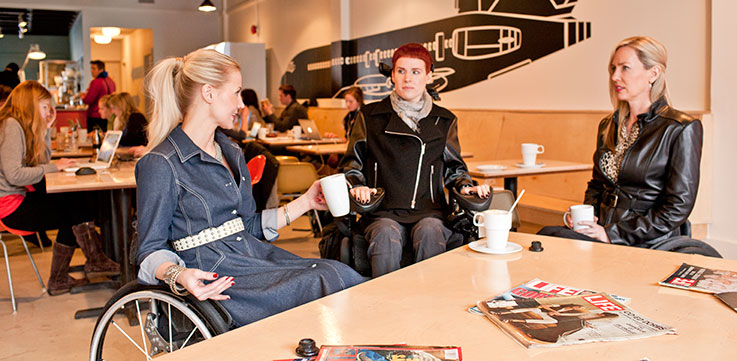
3 women in wheel chairs sitting around a table conversing wearing IZ Adaptive designs

Palmer characterizes Izzy’s work as “very important,” even “transformative.” Why? Her emphasis is on creating designs that make customers feel good about themselves, not just prioritizing ease of medical access or emphasizing caregiver assistance for dressing.

“She tries to solve physical function issues with the clothes while producing fashionable items,” Palmer notes, “and the result is her line of very clever clothes. They look nice. But while they may not seem not extraordinary, they are extraordinary.”

The IZ Adaptive line has not gone unnoticed by the fashion community, either. “Izzy has been called ‘Canada’s most PC (Perfectly Cut) fashion designer’ for good reason,” Palmer relates. “She has broken new ground by designing and creating pieces for maximum comfort, ease, and style for those who have traditionally had difficulty finding clothing that is affordable and that fits.”

While accessibility advancements have been made for people with disabilities in many areas, the need for adaptive clothing had been largely overlooked until Izzy’s line made its debut. Since off-the-rack clothing is worn sitting down or standing up, designers before Izzy didn’t consider the impact of sitting as a person’s only position in the way clothes hang on the body.

For example, Palmer notes the case of a young man who uses a wheelchair but who has to travel quite a bit for business. Before purchasing trousers from IZ Adaptive, he had to worry about his trousers bunching up or falling down whenever he transferred to an airplane seat. Now, he reports, can travel in comfort, without worrying about his trousers falling to his ankles.

With a designer’s steady eye for fashion and trends, Izzy incorporates the latest colors, quality fabrics, and durable materials as she shapes her designs. “We are constantly listening, learning and inspired by the needs and desires of our clients,” she says. “Details of easier closures and ease of dressing are always top of my mind.”

Her website is full of testimonials from people with disabilities who have found her products comfortable, practical, and fun to wear. SMG’s own CEO Carmen Jones is a particular fan of the IZ adaptive coats. Izzy comments, “Our pants and coats are our most frequently purchased items.” Although children’s styles are unavailable as of yet, Izzy notes that “as soon as they are teenagers, they can fit into our smaller adult sizes.”

Striking a Pose

The shop in Toronto, the IZ Adaptive website, and the museum exhibit all display Izzy’s designs on fiberglass “Mannequals” that show how the clothing looks from a seated position. An innovation in the world of fashion, the “Mannequal” was the focus of an national advertising campaign in England four years ago. It was designed by artist, activist, and model Sophie Morgan. A paraplegic after a 2003 car accident, Morgan has continued with a career, often bringing disability issues to the foreground in her role as BBC television presenter. You can learn more about the “Mannequal” at www.mannequal.co.uk or on Sophie Morgan’s own site at www.sophiemorgan.com.

Once customers see designs at IZ Adaptive that they like, they can follow detailed directions on how to measure for and order the items. Izzy notes that, while she does have a physical location in Toronto, “our location is not really a store but a showroom where we serve our clients. All of our samples are there for clients to order from. We have not needed the space to expand.”

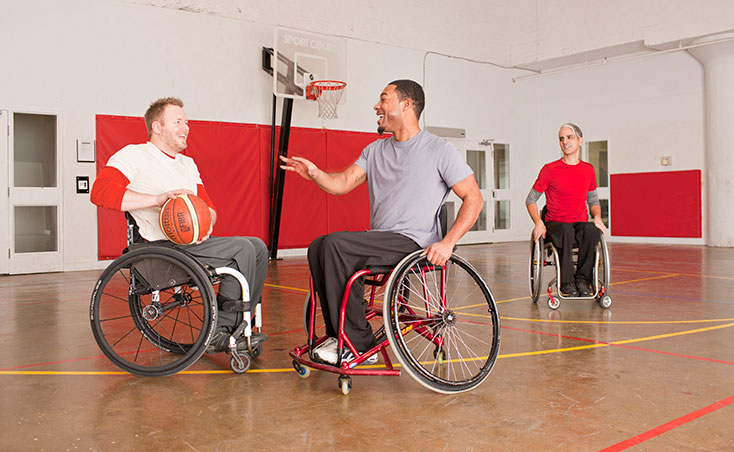
3 men in wheel chairs playing basketball wearing IZ Adaptive designs

Izzy credits an enhanced web presence, new images of actual clients modeling the collection, videos about the history of the line, and videos highlighting the features of the clothing all with contributing to an increase in sales. Social media, bloggers, mailing lists, and mainstream marketing efforts help as well. She notes that IZ adaptive has been actively working with organizations to help spread the word about the clothing line.

She is also implementing good old-fashioned low shipping fees. “We have just introduced free shipping for orders over $100 in North America,” Izzy reports, “and a $30 flat fee for orders over $150 for international orders.” While most of IZ Adaptive’s sales come from the United States, customers in Canada and Australia make up a sizable portion of her shoppers as well.

Future of the Line

The ROM exhibit, called Fashion Follows Form, runs until the end of 2014 and spotlights the unique and innovative features of the collection. As a point of comparison, 18th and 19th century clothing designed for sitting will be featured as well. Izzy says, “The exhibit will also feature some of my past high-end fashion design work, to show and demonstrate my background and roots.”
Palmer adds, “We hope this exhibition inspires visitors to think about the role fashion plays in our daily lives as well as the historical relationship between fashion and function.”

Izzy says, “We want wheelchair users, their families, and caregivers to know that our line of clothing is a better alternative to mainstream, standing-frame cut clothing. These clothes are easier to put on, save time while dressing, and make dressing easier for both wearer and dresser. Our line allows for all-day comfort, without style being sacrificed. I often explain that the line is secondary to what it delivers in terms of dignity, sense of self, inclusion, and peace of mind.”

Filed Under: Profiles in Excellence Leave a Comment

Tags: adaptive clothing, inlusion, IZ Adaptive, Izzy Camilleri

find this post helpful? Try these:

Izzy CamilleriWheels in Style—Adaptive clothing from Izzy Camilleri Target Store ExteriorTarget Scores Bulls-Eye Again
share

AXS Map: Making the Trip Easier

January 15, 2014

By Joan Leotta

GPS technology has worked wonders to help people lay out paths to new locations, but for those with impaired mobility, navigating those paths can be an exercise in overcoming unknown obstacles. For Jason DaSilva, problems with stairways, broken sidewalks and narrow or step-up entries began to mount with his diagnosis of MS in 2005. But rather than just accept these impediments, he created AXS (pronounced “access”) Map, a mobile app that allows users to locate truly accessible venues around town, find ways to get there and read reviews that rate the accessibility of neighborhood businesses.

Development of the Project

Axs Map LogoLike many people with mobility issues, DaSilva did not set out to take action that would make a difference to anyone—not even himself. “My first response [to everyday obstacles] was to try to simply go on,” he says. But when he fell in the sand on a family vacation in 2006, ignoring his MS was no longer an option. He turned to his mother for solace; she gave him something better: a challenge. She told him that he was privileged and talented and needed to do something about these difficulties.

This call to action sparked DaSilva’s creativity. A graduate of Vancouver’s prestigious Emily Carr University of Art + Design, DaSilva had already won awards for his films. Having observed firsthand the problems to be encountered while trying to get around using a walker, wheelchair or scooter, he soon envisioned a mapping device to let people with disabilities find the easiest routes to get around within a city and the location of accessible entrances to buildings. “It was 2007 when I got the idea for the mapping,” he says, “but the how of the project came later.” Getting others to share in the desirability of producing such a commodity was his next step.

In the meantime, DaSilva continued to receive awards for his total body of work, including films on Canadian television stations, HBO, PBS, CBC and Sundance. In 2008, he received an “Emerging Innovator” recognition at the Canada New Media Awards.

To apply his filmmaking skills to the problem of mobility, DaSilva, his wife Alice Cook and others including animator Mihai Wilson joined together to make a documentary. DaSilva served as the director and also as the main character, exploring his vision and highlighting the need for a mapping system. The resulting film “When I Walk” came out in 2009 and became the springboard for AXS Maps.

From Film to App

The film’s success spilled over into publicity for the mapping system, raising its profile enough to attract funding. “The film made the need for such a mapping apparent and helped people realize it was practical to devise such a system,” says DaSilva. “It was not until ‘When I Walk’ was finished that people realized the practicality of doing what I wanted with the mapping. In addition, the film highlights the mobility struggle of people with disabilities in ways that will hopefully provoke dialogue in every community where it is viewed.”

In 2011 DaSilva received a grant from Google Earth Outreach and some other foundations to build a prototype of the AXS Map, working with, among others, app developer Kevin Bluer. “We use Google Earth technology,” DaSilva explains, “to create something that can be put on the mobile telephone for both Android and Apple models.

Bluer and DaSilva first pitched the project, which they called “Maps for Good,” at the prestigious Google I/O conference. In June 2012, DaSilva partnered with AXS Lab, an organization dedicated to telling stories of disability through film, new media and technology, and renamed the app AXS Maps. Further work on the mapping app will include a new feature that enables users to upload photographs when sharing feedback.

The awards bestowed upon the film have continued to raise awareness of the app, which is free to use. The film and its maker were invited to show at the prestigious Sundance Film Festival in 2013, where “When I Walk” was very favorably reviewed. (It had not been entered in any of the competitions.) In competition at the Vancouver Film Festival later that same year, the film won “Best Canadian Feature, Hot Docs 2013.” People who want to bring the film to their communities or find out where it is showing can go to the website www.wheniwalk.com.

DaSilva hopes that AXS Map will provide those with disabilities greater freedom and spontaneity when navigating their communities and making everyday decisions. “I want AXS Map to serves as a tool to connect a growing network of like-minded people who support inclusive neighborhood practices and policies,” he says.

Filed Under: Profiles in Excellence Leave a Comment

Tags: accessibility, axs map, Jason DaSilva

find this post helpful? Try these:

Default ThumbnailAccessible Gaming: More Than Fun
share
  • « Previous Page
  • 1
  • …
  • 14
  • 15
  • 16
  • 17
  • 18
  • …
  • 20
  • Next Page »

Welcome

Whether you are interested in breaking ground in the market as a company, you are living with disability or love someone who is, we’re committed to keeping you abreast of what matters to people with disabilities—and why—so stay with us.

SIGN UP

Get the latest SMG updates in your inbox!


Categories

  • Featured
  • General
  • Notes from the Founder
  • Profiles in Excellence
  • SMG Tip
  • Video

Archives

  • March 2020
  • February 2020
  • May 2019
  • January 2019
  • November 2018
  • September 2018
  • August 2018
  • July 2018
  • May 2018
  • March 2018
  • February 2018
  • January 2018
  • December 2017
  • October 2017
  • September 2017
  • July 2017
  • May 2017
  • April 2017
  • March 2017
  • February 2017
  • January 2017
  • December 2016
  • November 2016
  • October 2016
  • September 2016
  • August 2016
  • July 2016
  • April 2016
  • March 2016
  • February 2016
  • January 2016
  • December 2015
  • November 2015
  • October 2015
  • September 2015
  • August 2015
  • July 2015
  • June 2015
  • April 2015
  • March 2015
  • February 2015
  • January 2015
  • October 2014
  • July 2014
  • January 2014
  • December 2013
  • November 2013
  • July 2013
  • June 2013
  • March 2013
  • January 2013
  • December 2012
  • October 2012
  • September 2012
  • July 2012
  • April 2012
  • December 2011
  • October 2011
  • August 2011
  • April 2011
  • February 2011

Contact Us

Quick Facts

The disability market consists of 56M people, representing an annual disposable income of $544 billion.

The disability market is more than twice as large as the tween market (20M), and has almost 3X the disposable spending power ($180B).

According to the U.S. Census Bureau, of the 69.6 million families in the U.S., 20.3 million families have at least one member with a disability.

A University of Massachusetts Boston survey found 92% of consumers felt favorably toward companies hiring people with disabilities; 87% prefer to do business with such companies.

By the year 2030, 71.5 million Baby Boomers will be over the age of 65 and demanding products, services, and environments that address their age-related physical changes.

Featured Clients

Darden Restaurants
American Express
AT&T
Sodexo
Bank of America
Wellcare
BlueCross BlueShield
ESPN
Zappos
Nike
Hilton
Get the latest SMG updates in your inbox!

678-805-7091 | info@disability-marketing.com

© 2026 Solutions Marketing Group

| a doodle dog creative website and brand